
PFAS / PFOS / PFOA Contamination
Per- and polyfluoroalkyl substances (PFAS) are a large group of man-made chemicals that have been used in a variety of industrial, commercial, and consumer products for decades. Two of the most widely recognized compounds within this group are Perfluorooctanoic Acid (PFOA) and Perfluorooctane Sulfonate (PFOS).
These compounds have been used in products designed to resist water, grease, stains, and heat. Applications have included certain firefighting foams, industrial processes, food packaging materials, textiles, carpeting, and other specialty products.
Because PFAS compounds are highly stable and resistant to natural breakdown processes, they are sometimes referred to as "persistent chemicals." As a result, PFAS contamination has become an area of increasing interest for environmental agencies, researchers, municipalities, industries, and water treatment professionals.
Why PFAS Has Become an Environmental Concern
PFAS compounds have been detected in soil, groundwater, surface water, and other environmental media in various locations around the world. Sources may include historical industrial activities, firefighting training areas, manufacturing facilities, landfills, and other locations where PFAS-containing materials were used or disposed.
Scientists, regulators, and environmental professionals continue to study the occurrence, movement, treatment, and long-term management of PFAS compounds in the environment.
Evaluating Treatment Technologies
A variety of treatment approaches are currently being evaluated for PFAS management, including activated carbon systems, ion exchange technologies, membrane filtration systems, and emerging treatment media.
The effectiveness of any treatment technology depends on numerous factors, including the specific PFAS compounds present, contaminant concentrations, water chemistry, flow rates, site conditions, regulatory requirements, and system design.
Ecochar-E and Pollutant Treatment Applications
Ecochar-E has been evaluated for use in pollutant treatment and environmental management applications. Testing has included analysis of contaminant adsorption characteristics, media performance, hydraulic properties, particle sizing, and related environmental treatment parameters.
Potential applications may include stormwater management, water quality improvement projects, environmental remediation evaluations, industrial treatment systems, and other site-specific environmental programs.
As with any treatment technology, performance should be evaluated through appropriate testing, engineering review, and regulatory consultation based on project-specific requirements.
Ecochar-E Pollutant Treatment Testing
Ecochar-E Pollutant Treatment % Removal
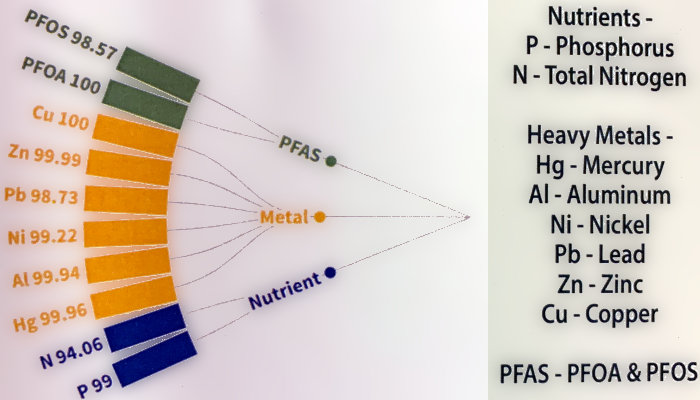
Testing and analytical evaluations referenced in the chart were conducted in accordance with applicable project protocols and environmental testing procedures. Evaluations included pollutant removal performance, hydraulic characteristics, media properties, and related environmental treatment parameters.
Referenced testing and analysis were performed by qualified laboratories and research organizations, including Stevens Institute of Technology, Spectrum, and Dakota Analytical. Testing was conducted to support evaluation of environmental treatment applications and regulatory compliance considerations where applicable.
Site-Specific Evaluation Is Important
PFAS management and remediation projects are highly site-specific. Environmental conditions, contaminant concentrations, regulatory requirements, treatment objectives, and project design considerations all influence technology selection and performance expectations.
Natural Char Solutions encourages consultation with qualified environmental engineers, regulatory agencies, water treatment professionals, and environmental consultants when evaluating PFAS treatment or remediation strategies.